PUBLISHER’S NOTE: THIS REVIEW CONTAINS INFORMATION ABOUT THE BOOK’S PLOT BEYOND WHAT IS ON THE BACK COVER COPY. THE REVIEW ALSO CONTAINS A FUNNY IN-BOOK JOKE ABOUT THE HOLOCAUST. SPOILERS APPEAR AFTER THE COVER IMAGE
Gary Barwin is an award-winning Irish-born Canadian poet and author whose honours include the Stephen Leacock Medal for Humour and the Canadian Jewish Literary Award.
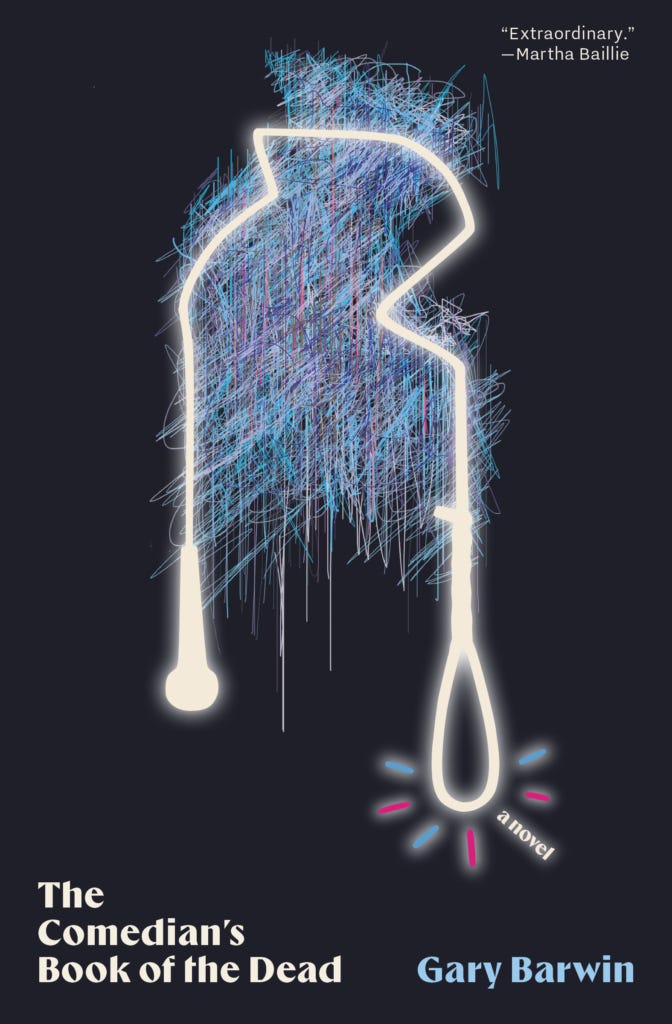
His 2026 novel, (available for sale here:) The Comedian’s Book of the Dead, published by Canadian-owned publisher Book*Hug Press, follows a deeply introspective artist, husband, and father turned reaper of souls. Fun fact: the premise of an ordinary guy turned grim reaper is one of the first times The Simpsons copied a Family Guy plotline.
The darkest joke in the book is a Holocaust survivor telling God a Holocaust joke. God doesn’t laugh. Holocaust survivor says, “I guess you had to be there.”
Barwin’s novel, however, examines what that situation could cost a person and their family. Death lives a half-life married to Betty and has an artsy, Grateful Dead fan son named Grigory. Grigory commits suicide. While taking another comedian down to the underworld, Death breaks against the rules of his responsibility and tries to bring Grigory’s soul back. It’s a modern Orpheus and Eurydice-style story about parental failure, at least that’s how it starts.
The morbidity is all packaged under a veil of dark comedy. The “committee” chose this stand-up comedian to collect souls. The concept of Death retiring is pretty funny. Does he have a spiritual pension, too? One scene has Death opening an underworld portal in IKEA because where else could be so confusing and spiritually alienating. Barwin leans so deeply into surrealist world-building that it’s not hard to imagine the pathway into the great beyond also having lingonberry frozen yogurt dispensers and $1.50 hot dogs. Scenes of Death’s old stand-up routines intercut the book. Dark comedy is often seen as insensitive, but it’s one of the best ways for those who’ve undergone tragedy to cope. Reminding yourself that nothing is too big or scary to laugh at does wonders at disarming trauma. The darkest joke in the book is a Holocaust survivor telling God a Holocaust joke. God doesn’t laugh. Holocaust survivor says, “I guess you had to be there.”
Introspective, the often poetic prose certainly is. The protagonist’s tortured mind circles around his deathly profession’s burdens on every page. You can really feel the weariness and jazzy rhythms pouring out of the page. The word “death” appears 372 times, like the word itself stains every corner of the protagonist’s mind. Talk about no work/life balance. Barwin’s writing favours emotional exploration and morose philosophical pondering over driving plot beats.
Death talks about and flashes back to Grigory’s childhood, mourning his innocence and ignorance of his dad’s profession. At times, the text is tragically ordinary, such as the kind of music they would bond over and Grigory’s goth phase. When Grigory commits suicide, it feels like it could’ve never played out any other way. That’s just how some brains are wired, to self-destruct. Death doesn’t stop blaming himself, though. He constantly wonders if he’s man first, reaper of souls second, or the other way around. The father’s failure is the reaper’s success, after all. Barwin captures the weight of the narrator’s self-blame and internal contradiction through constant questions about whether he deserves to be in this half-life state. And to have lost his son to suicide. It’s next-level survivor’s guilt. But even as an unstoppable force of nature, Death talks about his love of jazz and performing alongside other musicians. It’s a more literal adaptation to say that things of beauty can stick around long after your flesh and blood dissolves into dust.
Death’s greatest work of art is his son Grigory. The novel’s central metaphor is about parenthood. No parent wants to bury their kid, but Barwin exposes the tragedy of the ideal situation, where the kid must bury the parent. How could you want to force a loved one to do that? How selfish would you have to be? You’re spending your whole life as a parent preparing someone not to need you anymore. Life is a pretty raw deal. But the joy Death still feels for watching and protecting Grigory when he was alive shows that the deal is still worth taking. Reading this novel felt cathartic in a sense, as a form of dark fantasy fulfillment. If you’re mourning someone, Barwin offers a secular escape: imagining your loved ones in a place that isn’t necessarily better, but one they wouldn’t give anything to escape. Even in death, life goes on.
George Yonemori is an award-winning multimedia storyteller focused on literary, audio, film, and photography arts. He has been selected for mentorship by the Toronto International Film Festival, the Writers’ Union of Canada, and Darkspark. Global News, the Royal Ontario Museum, City of Toronto, Toronto Ward Museum, Scarborough Arts, Blank Spaces Magazine, Toronto Public Library, and more have featured his artwork. His favourite band is HEALTH, and he enjoys strawberry milkshakes. Subscribe to George’s Substack here: